
Cross-functional collaboration often appears in a brief as a broad aspiration: break silos, improve trust or communicate better. Those aims are understandable, but they do not tell a facilitator what people should do differently on Monday.
A useful workshop makes collaboration observable. It helps people handle a small number of high-friction moments better: deciding across competing priorities, handing work from one function to another, challenging assumptions without damaging the relationship and resolving an issue before it becomes an escalation.
Do not start with a generic teamwork agenda
Start with the work that crosses a boundary. Ask sponsors where progress repeatedly slows, what each function is protecting and what a good outcome requires from more than one team.
For example, “Marketing and Sales need to collaborate better” is too broad. “Marketing and Sales need to agree campaign readiness using the same evidence, with one owner for unresolved customer questions” is workshop-ready. It names the moment, the shared standard and the ownership gap.
If the diagnosis is still vague, use SEED's Training Needs Analysis Template or the guide to identifying manager capability gaps before building the agenda.
What the research suggests
Edmondson and Harvey's review of cross-boundary teaming explains why bringing different knowledge domains together can expand the ideas available to a team while also creating practical difficulty across boundaries. Diversity of expertise creates potential; it does not automatically create integration.
A meta-analysis of 116 empirical studies of intragroup conflict examined task, relationship and process conflict in relation to group outcomes. The practical lesson for workshop design is to distinguish disagreement about the work from confusion about responsibilities and from personal friction. Labelling all three as “communication problems” hides the intervention each one needs.
Marks, Mathieu and Zaccaro's team-process taxonomy separates transition, action and interpersonal processes. SEED's interpretation is that a collaboration workshop should rehearse all three: planning the work, coordinating while it moves and repairing tension when the process breaks down.
This work-based approach also fits Singapore's current workplace-learning direction. On 10 April 2026, the Institute for Adult Learning announced initiatives intended to move enterprises beyond fragmented training towards integrated work-and-learning solutions focused on workplace performance and sustained improvement.
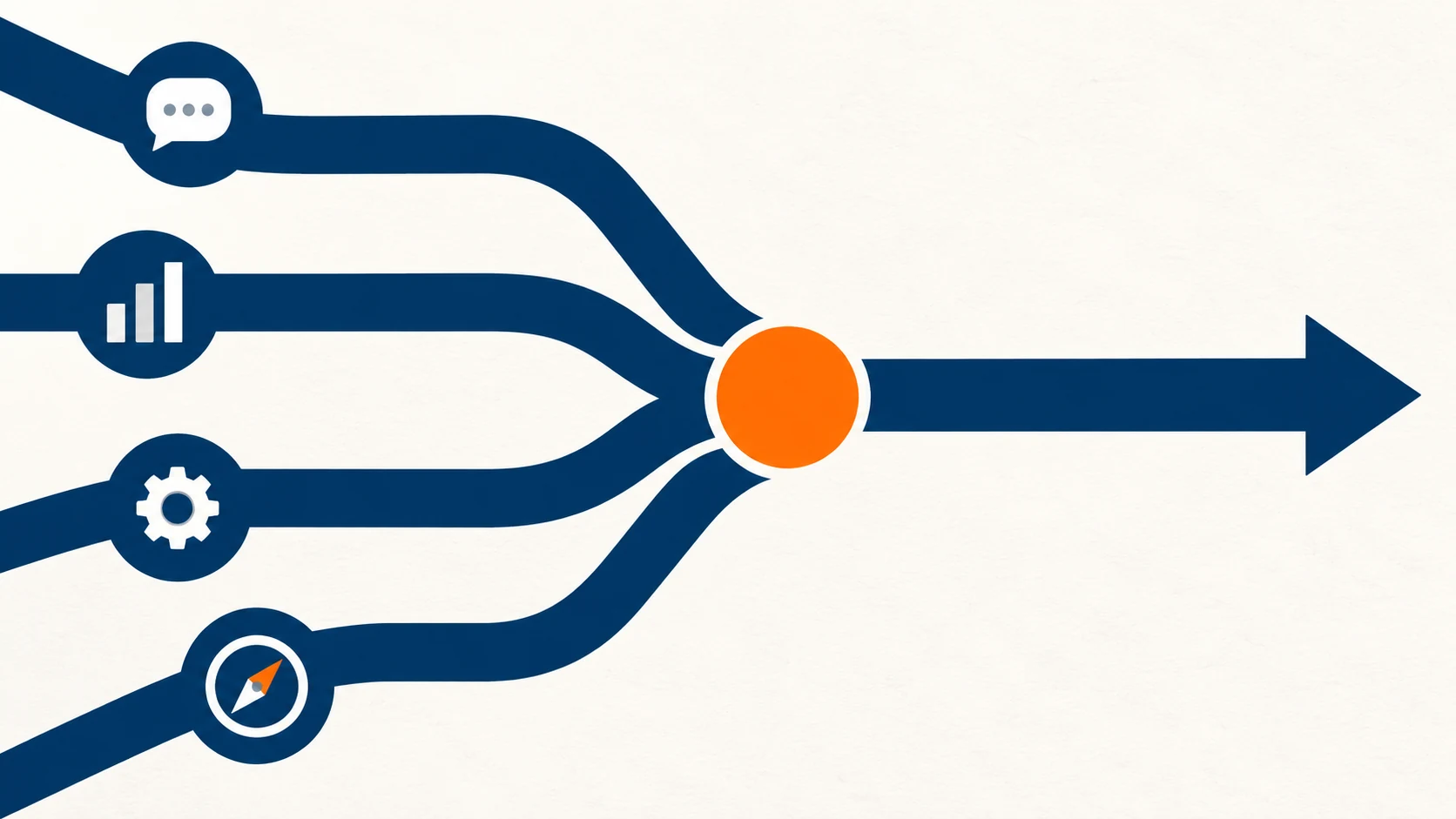
The Friction-to-Flow workshop framework
Locate friction
Name the exact cross-functional moment where work slows, loops or escalates.
Align the decision
Clarify the outcome, evidence, decision owner and constraints each function holds.
Rehearse the handoff
Practise the conversation, ownership transfer and escalation path using a real case.
Test in live work
Apply the agreement within seven days, capture evidence and adjust the operating rule.
The framework is deliberately operational. Trust can improve through better work together, but “build trust” is not a facilitation instruction. A team can practise whether it shares risk early, makes decision rights visible and closes a handoff without ambiguity.
Choose the right workshop target
| Observed friction | Likely workshop target | Practice task | Evidence after the workshop |
|---|---|---|---|
| Decisions reopen after meetings | Decision criteria and authority | Run one disputed decision using a shared decision brief. | Decision, rationale, owner and revisit trigger are recorded. |
| Work stalls between functions | Handoff quality | Give and receive a handoff with an acceptance check. | Fewer clarification loops or missing inputs. |
| Risks surface too late | Constructive challenge and escalation | Raise a risk using evidence, impact and a requested decision. | Risks are raised earlier and routed to the right owner. |
| Meetings create updates, not action | Shared outcome and closure | Convert a status discussion into decisions, actions and dependencies. | Named owners, dates and unresolved dependencies are visible. |
| Functions optimise different goals | Trade-off language | Compare options against a shared outcome and explicit constraints. | Trade-offs are stated rather than negotiated through delay. |
Do not try to solve every pattern in one session. Select one primary moment and, at most, one connected secondary moment. A narrow workshop with realistic repetition usually creates more usable behaviour than a full day of disconnected collaboration concepts.
A practical half-day agenda
| Time | Activity | Output |
|---|---|---|
| 0:00–0:25 | Map one live workflow and identify where value, information or authority gets stuck. | A shared friction statement. |
| 0:25–0:55 | Surface each function's customer, constraint, risk and non-negotiable. | A boundary map without blame. |
| 0:55–1:25 | Agree the decision, decision owner, contributors and evidence needed. | A one-page decision brief. |
| 1:25–1:40 | Break. | — |
| 1:40–2:35 | Rehearse the decision or handoff twice: first as usual, then with the new operating rule. | Observed behaviour and feedback. |
| 2:35–3:05 | Stress-test the rule against urgency, hierarchy, missing data and disagreement. | A clear escalation path. |
| 3:05–3:30 | Choose a live application within seven days and assign a review date. | An owner, workplace test and evidence source. |
The first rehearsal reveals the existing pattern. The second lets participants try a better one. Observers should use a small behaviour scorecard rather than offer general comments about confidence or style.
Use a behaviour scorecard
- The shared outcome was stated before functions argued for their preferred solution.
- Each function's constraint and risk were surfaced without dismissing them.
- The decision owner and contributor roles were explicit.
- Disagreement focused on evidence, assumptions and trade-offs—not motives.
- The handoff included required inputs, acceptance criteria and a due date.
- The escalation path named when, where and to whom an unresolved issue moves.
- The conversation closed with owners, actions and a review trigger.
Use the same scorecard during practice and live application. That creates a common observation language and makes follow-through lighter. It also prevents the post-workshop discussion from collapsing into “the meeting felt better”.
Decide whether a workshop is enough
A workshop fits when several people need a shared operating approach and can practise the same cross-functional moment together. It is not the complete answer when the friction comes from incompatible incentives, unclear governance, missing decision rights or an unresolved leadership conflict.
| If the root cause is… | Add or use… | Why |
|---|---|---|
| A missing shared method | Workshop | Builds common language and repeated practice. |
| Different live challenges across teams | Workshop plus group coaching | Creates consistency, then supports contextual application. |
| Unclear authority or governance | Sponsor-led operating design | Training cannot grant decision rights. |
| High-stakes personal tension | Team or individual coaching | Allows deeper contracting, reflection and repair. |
| A regional or multi-cohort need | Programme design | Connects shared standards with local cases and reinforcement. |
SEED's workshop-versus-coaching decision guide can help with the format choice. For a larger initiative, the leadership programme design guide shows how to connect diagnosis, practice, application and evidence.
Make the case safe enough to be real
The best case is close to live work but does not require participants to expose confidential details or defend past decisions. Replace names and sensitive numbers, while preserving the competing constraints, dependencies and decision pressure.
Give every function a legitimate concern. If one role is obviously correct, the exercise teaches compliance rather than collaboration. Good cross-functional practice requires a real trade-off: speed versus risk, consistency versus local context, customer experience versus operational capacity or near-term delivery versus long-term capability.
Plan the seven-day workplace test
Before participants leave, select one real meeting, decision or handoff where the new operating rule will be used. Name the owner, an observer and the evidence to bring back.
- Situation: Where will the team apply the rule?
- Behaviour: Which two or three scorecard items matter most?
- Evidence: What decision record, handoff, work product or observation will show what happened?
- Review: When will the team compare the result with the old pattern?
- Adjustment: What will be kept, changed or removed from the operating rule?
If the workshop is part of a wider learning journey, connect this test to the 30-day learning transfer plan. Application should be part of the design, not a follow-up email sent after energy fades.
Questions to ask a workshop provider
- How will you diagnose the cross-functional moment before designing the agenda?
- What real decisions, handoffs or trade-offs will participants practise?
- How will you prevent the session from becoming a generic team-building event?
- What will observers look for during practice?
- How will live cases be used without compromising confidentiality?
- What workplace test and reinforcement will happen after the session?
- How will you identify issues that need governance or sponsor action rather than training?
Design for better work, not better workshop ratings
A cross-functional collaboration workshop succeeds when teams handle a recurring piece of work more clearly after the session. The output is not a list of values. It is a better decision, handoff, escalation or operating agreement that people have already rehearsed.
If your team needs focused practice around a real collaboration challenge, explore SEED Academy's Workshops & Masterclasses. For multi-team or regional capability needs, review Training Programme Design or start a capability conversation.
Sources
- Edmondson, A. C. & Harvey, J.-F. (2018), Cross-boundary teaming for innovation: Integrating research on teams and knowledge in organizations.
- de Wit, F. R. C., Greer, L. L. & Jehn, K. A. (2012), The paradox of intragroup conflict: A meta-analysis.
- Marks, M. A., Mathieu, J. E. & Zaccaro, S. J. (2001), A temporally based framework and taxonomy of team processes.
- Institute for Adult Learning Singapore / Singapore University of Social Sciences (10 April 2026), People-Driven Innovation Strategy announcement.